In Spanish football, tactical identity has long been anchored in the manipulation of pitch geography. Positional play relies on structural geometry, dividing the pitch into specific zones and passing lanes to guarantee superior angles of support and continuous ball circulation. Teams use short build-up mechanics deep within their own defensive third. By involving the goalkeeper and central defenders as active outfield distributors, the attacking structure baits the opposition into committing numbers forward. This invitation of pressure stretches the opponent's defensive lines, creating vertical pockets between their midfield and backline that transform deep possession into an offensive launchpad.
Once initial pressure is neutralized, the emphasis shifts toward controlling the match tempo through central numerical overloads. The strategic deployment of inverted full-backs, dropping forwards, and fluid midfield interiors creates localized superiority in the central corridors and half-spaces, dictating the rhythm of play and suffocating transitional threats. When confronting entrenched low blocks that refuse to press high, this methodology relies on strict positional discipline. By maintaining structural width through touchline wingers and shifting defensive reference points across the pitch, possession-oriented systems dismantle compact defensive blocks, manipulating structural integrity until high-probability passing lanes naturally appear.
Foundational Principles of Geometry and Space
Structured build-up play rests on the deliberate rationalization of the pitch into specific geometric zones, primarily divided into five vertical corridors and multiple horizontal strata. This framework mandates that teammates rarely occupy the exact same horizontal or vertical line simultaneously, which inherently creates continuous passing networks formed of triangles and diamonds. By establishing these angular relationships, the ball carrier consistently maintains at least two immediate passing options, thereby distributing passing risk and neutralizing defensive pressing angles. The primary objective is to maintain structural balance, ensuring that the team remains compact enough to enable short, controlled circulation while stretching the opponent across the maximum width and depth of the playing surface.
Beyond static positioning, this geometric discipline enables the systematic manipulation of opposition cover shadows and defensive blocks. The arrangement allows teams to generate positional superiority, placing receivers between the opponent's defensive and midfield lines, particularly within the half-spaces where defensive marking responsibilities frequently blur. From these coordinates, the fundamental mechanism of the third-man run involves an initial vertical pass that draws defensive pressure, triggering an immediate lay-off to a supporting midfielder who can find a free runner facing the opponent's goal. Through these calculated spatial dynamics, short build-up is an active tool for systematically disorganizing structured defenses.
Drawing Pressure Through Deep Build-Up Mechanics
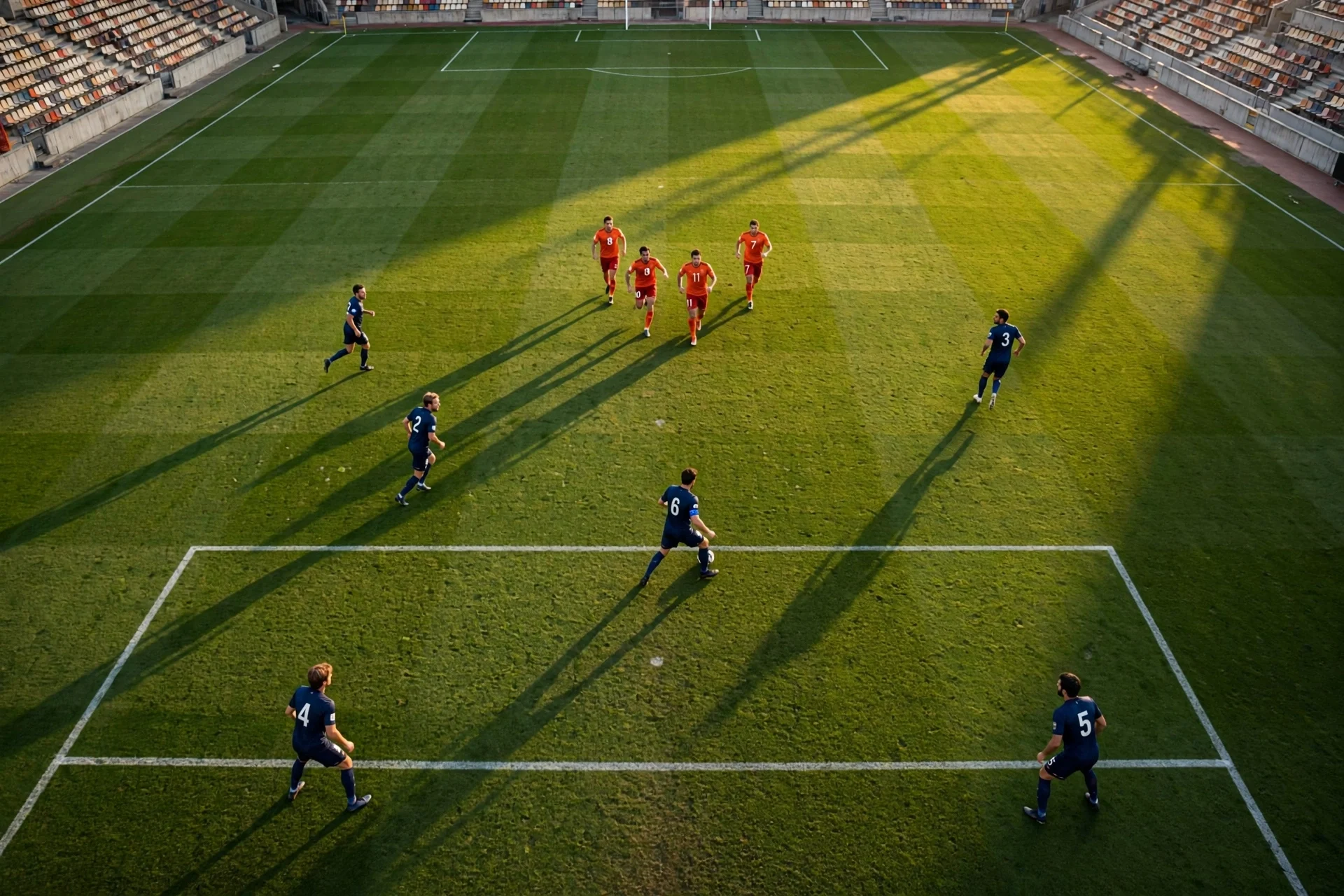
Deep build-up mechanics in modern Spanish football function primarily to manipulate the opponent's defensive structure and bait the press. Central to this approach is the goalkeeper acting as an additional outfield player, creating a situational numerical advantage inside the defensive third. Center-backs split wide toward the touchlines, while the deepest central midfielder drops into the immediate vicinity to form dynamic passing triangles. By circulating possession at low tempos, often using the tactical pause on the ball to entice challenging forwards, the deep build-up forces the pressing team to push their lines higher up the pitch. This controlled baiting lengthens the playing area, stretching the vertical distance between the opponent's defensive and attacking units.
Once the pressing unit commits its forward and midfield lines to disrupt this deep circulation, the underlying objective of the sequence materializes. Teams exploit the resulting structural voids through predetermined passing patterns, notably third-man combinations and wall passes. A central pivot or an inverted full-back momentarily fixes an opposing marker before laying the ball off to a forward-facing midfielder positioned between the lines. By consistently generating clean progression angles under intense pressure, sides rooted in positional play turn defensive-third possession into advantages higher up the pitch and destabilize the opposition's defensive block.
Controlling Tempo via Central Numerical Overloads
In the context of Spanish football, the central zone serves as the primary engine for game management, where controlling the rhythm depends heavily on establishing numerical superiority. Tactical structures routinely evolve during the build-up phase to pack the midfield, often using inverted fullbacks who tuck into the half-spaces or a center-forward who drops between the opponent's defensive and midfield lines. By forming diamond and triangular passing networks, the team in possession generates multiple viable passing angles, effectively neutralizing aggressive central pressing. This spatial dominance minimizes turnover risks in high-leverage areas and forces the opposition into a passive stance, as the defensive unit must constantly shift laterally to cover the extra central player without exposing passing lanes into the final third.
This structural superiority directly dictates the tempo, allowing the possessing side to alternate between measured circulation and decisive penetration. By continually finding the free interior midfielder, the attacking team can deliberately decelerate play, drawing the opposition block higher or wider before accelerating through vertical line-breaking passes. Moreover, congregating numbers centrally provides an immediate counter-pressing foundation; should possession be lost, the proximity of multiple players enables rapid ball recovery, thereby preempting direct counter-attacks. Consequently, central overloads function as a preventative defensive strategy that suffocates transition-heavy opponents and maintains prolonged match control.
Dismantling Low Blocks with Positional Discipline
In Spanish football, encountering a compact low block is a routine structural challenge for possession-oriented teams. When defending sides compress the space between their defensive and midfield lines, they effectively eliminate central passing lanes and force the play toward the flanks. Positional play counteracts this containment by prioritizing strict spatial distribution. Attacking players hold designated reference points across the pitch, stretching the opponent horizontally through maximum width provided by touchline wingers or full-backs, and vertically through central attackers pinning the opposing center-backs. This deliberate spacing prevents the defensive unit from shifting collectively without conceding dangerous pockets of space. Patience in possession dismantles defensive density.
Breaching these congested setups relies on rapid, calculated ball circulation designed to exploit the micro-moments of disorganization that occur as the defending block shifts across the pitch. By moving the ball from side to side through deep-lying midfielders and stepped-up central defenders, the attacking side forces the defensive lines to constantly adjust their angles of cover. This systematic shifting eventually opens interior passing corridors into the half-spaces, where attacking midfielders or inverted wide players can receive the ball on the half-turn between the lines. From these advanced areas, positional discipline enables coordinated combinations such as third-man runs and blind-side movements into the penalty area that penetrate the structure before the defensive block can reset. Sustained territorial dominance achieved through this method also establishes an optimal rest-defense, so the attacking team can immediately counter-press and recycle possession if a pass is intercepted.
Conclusion
The prevalence of positional play across Spanish football reflects a structural commitment to controlling the pitch through spatial geometry and precise ball circulation. By using deep build-up mechanics to bait opposition pressure, sides systematically generate the passing lanes necessary to establish numerical superiorities across the central channels. This calculated manipulation of territory allows teams to dictate the tempo of the contest, ensuring that possession functions as a deliberate mechanism to manipulate the opponent's defensive shape.
The mastery of these interconnected principles matters most when confronting compact low blocks, where rigorous positional discipline is required to unlock stubborn defensive structures. Rather than relying on direct, transition-heavy verticality, the patient occupation of specific zones and the continuous recycling of play provide a systematic method for creating high-value attacking breakthroughs. The short build-up remains the defining tactical approach for controlling games and breaking down organized resistance.