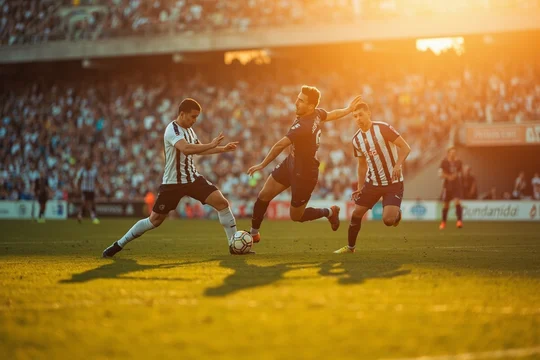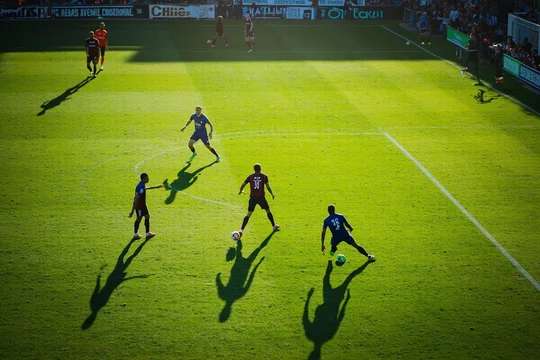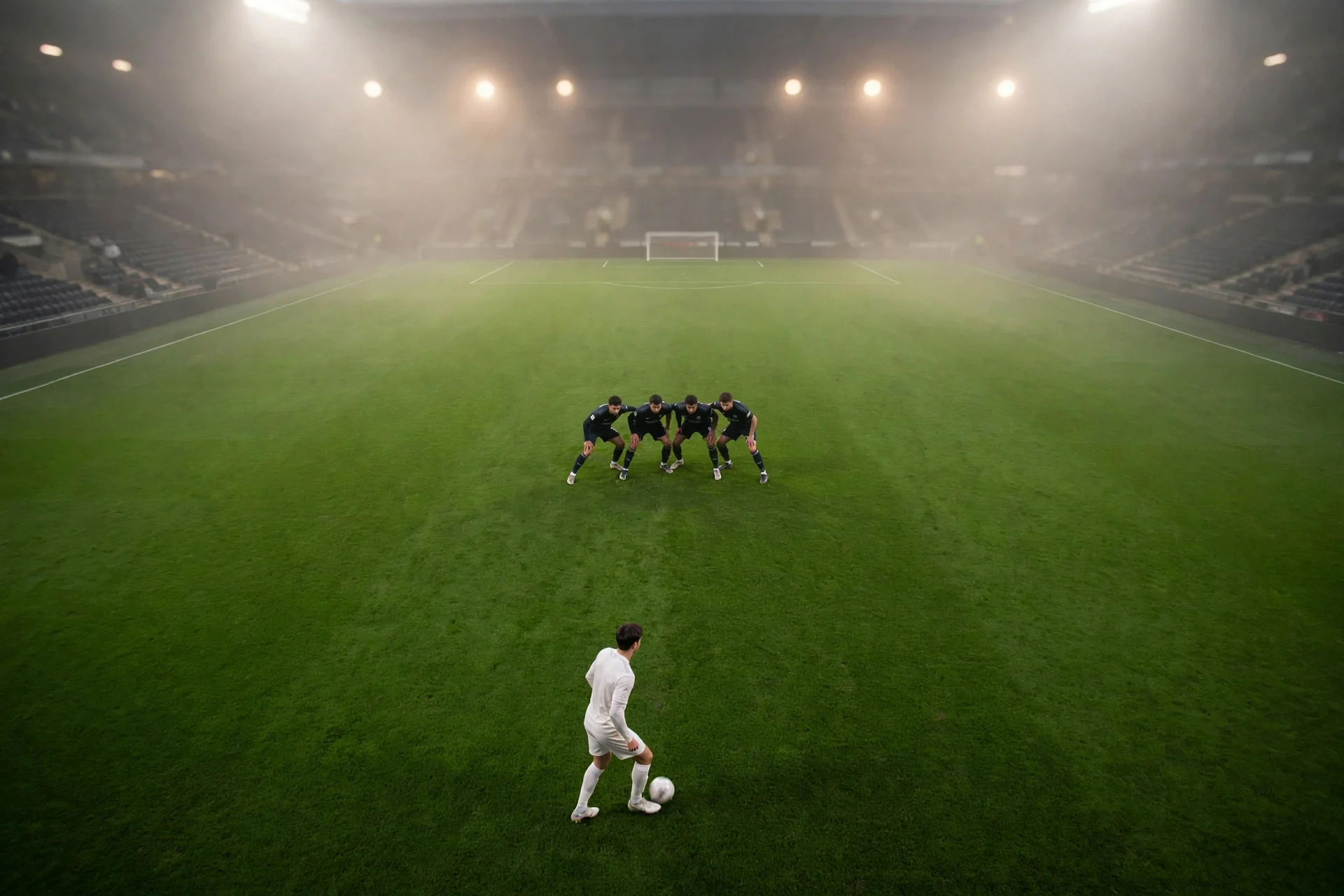
Tactical identity in Serie A has long rested on spatial discipline, and the compact midfield block is the league's most familiar answer to possession-heavy opponents. The defending side shrinks the horizontal and vertical distances between its midfield and defensive lines until there is almost no room to receive between them. Central playmakers and inverted wingers lose the half-turn reception they depend on, and the team in possession drifts toward the flanks, where the touchline limits every pass and long spells of territorial control tend to end in a hopeful cross.
The block does more than wait. It leaves certain passes open on purpose, collapses on the receiver when a set cue appears, and uses the density it built in the centre to counter the moment the ball is won. Opponents who push their full-backs and central overloads forward to break it down leave the most space behind them, and that space is where the block does its damage.
Suffocating Central Progression Between the Lines
Against possession-oriented systems, Italian mid-blocks start with distances. The defending team does not chase the ball in an expansive press. It keeps roughly 10 to 15 metres between the midfield line and the back line, and the tightest units hold it nearer 10. That gap is where opposing creative midfielders and inverted wingers want to receive, and at that size it barely exists.
When a deep-lying playmaker looks for a forward pass, the central midfielders in front of him have already shifted with the ball and stand across the lane. They screen with their cover shadows instead of rushing the ball carrier, so the pass he wants is blocked before he can play it. Behind them, the back line steps up together, and any forward who drops in to receive takes contact on his first touch.
If the team in possession forces the ball into that corridor anyway, the nearest midfielders collapse inward and the closest centre-back steps out to press from behind, closing the receiver from two or three angles at once. He loses time and vision, and the ball is often turned over in a zone where the defending side already has numbers. After a few of these, the possession team stops trying the middle. Its circulation becomes a slow U-shape around the edge of the block: centre-back to full-back, back to centre-back, across to the other full-back.
Funneling Possession Into Low-Risk Wide Channels
Closing the centre is half the plan. The other half is deciding where the ball goes instead. With a double pivot or a pair of screening midfielders sealing the interior pockets, playmakers who try to receive on the half-turn find a marker on their back. The easy option becomes a lateral pass to a full-back or a winger standing on the touchline, and the defending team is happy to concede it, because a ball near the touchline is a ball far from goal.
Once play goes wide, the block has a geometric advantage. The touchline removes half of the ball carrier's passing angles, so the defenders only need to cover the inside. The whole unit slides across together without losing its vertical compactness, which lets the wide midfielder and full-back double up on an isolated winger or pin the opposing full-back against the line.
Crosses from deep wide positions favour the defence. The centre-backs and goalkeeper face the ball and have the better view of its flight, while the attackers are running across them. Denied cutbacks from the byline and combinations through the half-space, the attacking side ends up floating balls into a crowded box or passing back to its own centre-backs, and a large share of possession produces very little.
Coordinated Pressing and Passing Traps
A compact block presses on predetermined triggers instead of chasing for 90 minutes. It holds its distances and waits for a recognisable mistake. The common cues are:
- a misdirected or under-hit pass in the central third
- a loose lateral ball to a full-back with no support nearby
- a central midfielder receiving with a closed body shape, facing his own goal
When one appears, the unit moves at once. The forwards angle their runs to cut the return pass to the centre-backs, and the midfield line steps up as one band to take away the ball carrier's vision and his vertical options.
Some traps are built by conceding a pass on purpose. A deep-lying playmaker or interior midfielder is left apparently free, which tempts the opposition into a forward pass through the congested centre. While the ball travels, nearby midfielders close from the receiver's blind side and a centre-back steps out of the line to stop him turning. The defending team now has a numerical surplus around the ball, and the turnover happens where the attacking side is stretched and least prepared to defend a quick counter.
Vertical Transitions Against High Lines
A narrow, dense midfield encourages possession sides to push their own defensive line toward halfway to stay compact behind their attack. They also spread out while they have the ball: full-backs advance, centre-backs split wide to circulate, and the players left to defend a counter get fewer and further apart. The territorial control that results is partly something the block has allowed.
When the ball is won, usually through an interception in the crowded central corridor, the recovering team goes forward at once to beat the opposition counter-press. It already has numbers near the ball, so the first pass can go forward without a slow build. Forwards waiting on the shoulders of the advanced centre-backs attack the space behind, or a target forward receives into feet and lays the ball off to midfielders running past him. The aim is a shot before the possession side has set its rest defence or brought its full-backs back.
Direct play of this kind turns the next few seconds into a race. Opposing centre-backs, running toward their own goal, have to choose between holding an offside line and retreating to protect the box. That hesitation often separates the recovering midfield from the back line and opens an intermediate channel for a second runner arriving from deep.
What the Block Asks of Each Line
The shape only holds if every unit knows its job without the ball. In most Serie A versions the duties split like this:
- Forwards angle their pressure to block the pass back to the centre-backs and stay close enough to the midfield to keep the block short.
- Central midfielders shift with the ball, screen passing lanes with their bodies, and collapse inward when a trigger fires.
- Wide midfielders track the full-back's run, then double up with their own full-back once the ball reaches the touchline.
- Centre-backs step up in unison, and the nearest one steps out to meet any receiver dropping between the lines.
Back-three sides in Italian football run the same duties with an extra centre-back, which lets one of the three step out without leaving the line short. A compact midfield block built on these roles can concede most of the ball and still decide where the game is played, which is the idea behind controlling matches through spatial dominance instead of possession. The possession side gets the touchline and the crowded box, and the defending side gets the central turnover and the empty half behind a high line.