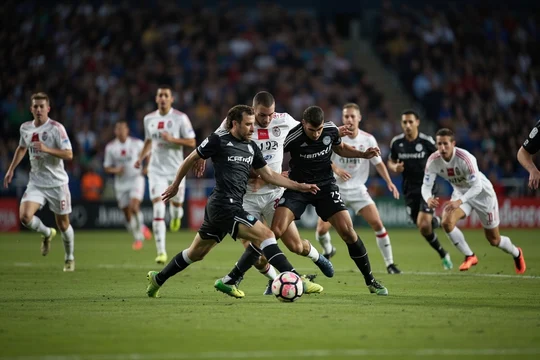
Gegenpressing, or counter-pressing, operates on the principle that the moment possession is lost represents the optimal window to regain it. Rather than retreating into a structured defensive block, teams employing this strategy exploit the transient seconds of negative transition, during which the recovering opponent is at their most tactically disjointed. Initiated by specific triggers, such as an inaccurate pass, an uncontrolled touch, or a touch directed toward the touchline, the pressing collective aggressively compresses the space around the ball carrier. Through coordinated angles of approach and the deliberate shadowing of passing lanes, the unit creates directional traps designed to eliminate safe release valves, suffocating the carrier and forcing immediate turnovers in high-leverage areas.
The functional viability of this approach hinges entirely on the physical and cognitive thresholds of the squad. Players must possess elite aerobic endurance and high-intensity repeat-sprint capacity, paired with superior spatial awareness and the predictive intelligence required to anticipate play a sequence ahead. Yet, the extreme vertical compactness that defines counter-pressing also introduces acute structural vulnerabilities. Committing multiple outfielders to the immediate ball zone inevitably vacates vast expanses of pitch, particularly behind an advanced defensive backline. When resisting sides execute disciplined countermeasures, such as rapid diagonal switches, direct vertical long balls into unoccupied channels, or quick third-man combinations, they can bypass the initial wave of pressure entirely and attack under-protected backlines in transition.
Immediate Recovery Triggers and Transition Windows
The tactical viability of counter-pressing relies on a brief, highly vulnerable phase known as the transition window. The moment an opponent recovers the ball, their tactical shape shifts from compact defensive organization to expansive attacking width and depth. In these initial seconds, the player who has won possession is often off-balance, adjusting from defending to distributing, and temporarily lacks spatial awareness. Simultaneously, teammates disperse outward to offer progressive passing options, vacating central defensive cover and stretching their lines. Counter-pressing exploits this structural instability. By suffocating the ball carrier before they can stabilize possession or establish passing lanes, the pressing team capitalizes on an opponent caught between two opposing tactical mindsets.
Predetermined recovery triggers coordinate this rapid pressure. A tactical trigger is an observable on-pitch cue that signals surrounding players to converge simultaneously on the ball. Common triggers include an opponent receiving possession with their back to the field of play, an uncontrolled or heavy first touch, an interception forced into a congested touchline, or the ball falling to an opponent with limited distribution capabilities under duress. When a trigger registers, the nearest player closes the ball carrier's immediate radius to eliminate forward vision, while secondary and tertiary teammates cut off short passing options using their cover shadows. If the ball remains unrecovered within the primary window, the pressing unit must recognize the failure of the trigger and retreat into a compact zonal block before the opponent can exploit the space left behind.
Spatial Compression and Passing Lane Traps
spatial compression relies on the immediate, coordinated collapse of multiple players toward the ball the moment possession is lost. The nearest unit reduces the physical space around the ball carrier, while the defensive line steps forward in tandem to eliminate vertical separation between units. This coordinated squeeze effectively shrinks the playable pitch into a localized, suffocating zone. By denying both horizontal width and vertical depth, the counter-pressing side removes the opponent’s time to assess the field, forcing the ball carrier to act under extreme cognitive and physical duress, which significantly increases the likelihood of an unforced technical error.
Alongside this physical constriction, teams employ passing lane traps to dictate where the rushed clearance or pass must travel. Pressing players use angled approaches and cover shadows to obstruct dangerous progressive outlets while deliberately leaving seemingly viable avenues open. These apparent escape routes, often directed toward the touchline or a heavily marked central midfielder, are pre-calculated traps. Once the trapped pass is initiated, secondary pressers converge on the anticipated receiver before the ball can be properly controlled, enabling the pressing team to regain possession in high-value territory against a structurally disorganized opponent.
Physical and Cognitive Squad Profiles Required
Executing an effective counter-press demands an elite threshold of anaerobic capacity and rapid physical recovery. Players cannot rely solely on steady-state endurance; winning the ball back immediately after a turnover requires repeated, explosive short sprints and sharp decelerations. Wide attackers and central midfielders, in particular, must demonstrate exceptional acceleration to close down passing angles within the critical first few seconds following the loss of possession. Concurrently, fullbacks and central defenders must possess the recovery speed required to operate comfortably with a high defensive line, mitigating the risk of long clearance passes into the open space behind them. Without a squad capable of sustaining these high-intensity physical metrics over the full duration of a match, the structural integrity of the press fractures and exposes gaps between the lines.
Beyond physical output, counter-pressing relies on perceptual awareness and immediate cognitive processing. Players must recognize transitional triggers, such as an opponent receiving the ball with a closed body shape, an inaccurate pass, or an insecure first touch, before the turnover is fully realized. This requires predictive intelligence, where individuals anticipate phases of play instead of reacting to the movement of the ball. Collective synchronization is equally necessary; if the forward line initiates a pressing trap while the midfield unit hesitates to compress the intermediate space, the opponent can easily bypass the pressure. Consequently, players require the tactical discipline and mental clarity to make split-second decisions under fatigue, balancing calculated aggression with the spatial restraint needed to prevent defensive disorganization.
Structural Vulnerabilities and Tactical Countermeasures
The immediate commitment of multiple outfield players to the ball upon possession turnover inherently distorts a team’s defensive architecture. By compressing around the targeted recovery zone, the counter-pressing side vacates the opposite flank and exposes the expansive space behind an aggressive, high defensive line. If the opposition breaks through the initial wave of pressure via precise one-touch passing, a third-man release, or an escape dribble, the pressing unit is caught severely unbalanced with minimal cover. Furthermore, the immense metabolic cost required to sustain collective, high-velocity sprints throughout ninety minutes naturally generates progressive physical and cognitive fatigue. As physical output declines late in a match, the pressing intervals widen by fractions of a second, leaving the central channels and the half-spaces vulnerable to exploitation by competent transitional attacks.
To neutralize this aggressive hunting mechanism, opposing coaches commonly implement tactical countermeasures built on extreme verticality or calculated press-baiting. Direct, aerial distribution toward a physically dominant target forward bypasses the midfield congestion entirely, transforming the counter-press into a chaotic battle for uncontrolled second balls while the pressing defensive line is forced to retreat toward its own goal. Alternatively, press-resistant sides employ deep overloads and rapid diagonal switches to draw the pressing pack into a tight quadrant before suddenly releasing the ball into the isolated weak side. To counteract these exploitative maneuvers, sophisticated counter-pressing frameworks increasingly rely on rigid rest defense protocols, where non-pressing central defenders and inverted fullbacks prioritize structural positioning and passing-lane obstruction over blind pursuit of the immediate ball carrier.
Conclusion
Counter-pressing operates as both a defensive safeguard and an offensive catalyst, predicated on the immediate exploitation of the transitional phase. By applying coordinated pressure during the seconds immediately following possession loss, teams compress available space, trap escape routes, and force hurried turnovers in advantageous areas. However, sustaining this approach demands exceptional physical endurance, rapid cognitive processing, and collective synchronization, as even a momentary delay by a single player can collapse the entire pressing structure.
Despite its tactical efficacy, the system introduces structural vulnerabilities, particularly in the vacated space behind an aggressive high defensive line. When opponents possess the technical composure and discipline to bypass the initial wave through direct vertical releases or rapid switches of play, the pressing side faces severe transitional exposure. The viability of counter-pressing hinges on calculated risk management, recognizing precisely when to sustain pressure and when to abandon the trap to preserve defensive equilibrium.