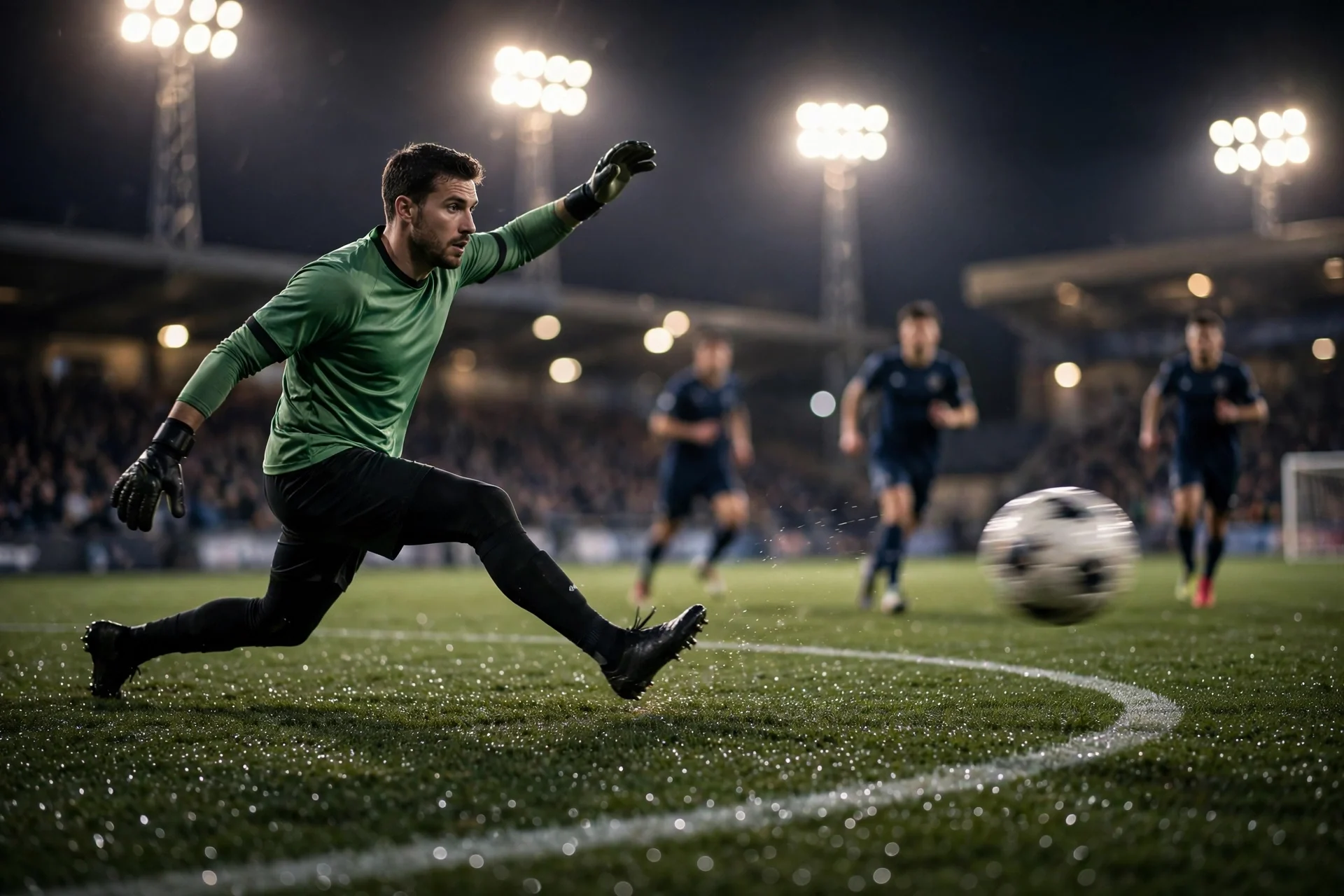
In contemporary football tactics, the goalkeeper serves as the foundational playmaker in the build-up phase. Stepping beyond the penalty area to participate in possession creates an immediate numerical superiority against aggressive high-pressing schemes, turning the goalkeeper into an extra deep-lying outfield player. To exploit this structural advantage, modern goalkeepers must execute varied deliveries under pressure, ranging from line-breaking ground passes into central midfield to measured diagonal balls designed to isolate wingers against retreating defensive lines.
This proactive approach balances system-wide control against the threat of catastrophic errors, as losing possession within the defensive third almost inevitably grants the opponent a high-probability scoring opportunity. Managing this risk requires composure and rapid spatial awareness, prompting a shift in how the position is evaluated. Recruitment departments and analytical models now look beyond traditional metrics such as raw save percentages and reflex speed, prioritizing data on passing range, resistance to pressing, and launch decision profiles.
Creating Numerical Superiority in Build-Up Play
In traditional tactical frameworks, the build-up phase pitted ten outfield players against ten opponents, with the goalkeeper restricted to the goalmouth as a purely reactive presence. Modern tactical systems exploit the goalkeeper as an active eleventh player, inherently manufacturing a permanent numerical advantage in the first phase of possession. When an opposing side commits to a high press, they face a fundamental structural dilemma. If they choose to press man-to-man against all outfield options, the goalkeeper remains unmarked and free to scan the pitch, advance possession, and control the tempo. Conversely, if a forward steps forward to close down the goalkeeper, a passing lane inevitably opens to an outfield teammate, allowing the team in possession to bypass the first wave of the press with precise, short circulation.
To maximize this overload, teams routinely alter their defensive geometry, splitting the center-backs wide toward the edges of the penalty area while the goalkeeper steps up between them to form a temporary back three. This positioning artificially expands the pitch, stretches the pressing team's front line, and opens vertical channels into deep-lying central midfielders. By baiting the opposition forward, the goalkeeper effectively acts as a deep playmaker who can either break lines with grounded passes or switch play to full-backs occupying space vacated by an overshifted defense. Ultimately, generating numerical superiority in the defensive third is not merely a tool for ball retention, but a calculated strategy designed to dismantle an opponent's pressing structure from the very base of the formation.
Expanding the Distribution Repertoire Under Pressure
Modern high-pressing systems have fundamentally altered the demands placed on a goalkeeper during the build-up phase, rendering simple clearances obsolete. Rather than merely pumping the ball downfield into contested 50-50 aerial duels, the modern shot-stopper must execute a diverse array of deliveries while facing aggressive pursuit from opposing forwards. This repertoire demands high technical execution across multiple ranges, including clipped passes over an advancing winger to an isolated full-back, low driven balls that split the first line of pressure to find a central pivot, and floated diagonal switches into vacated wide spaces. Mastery of both feet has evolved from an advantageous trait to an absolute necessity, allowing the goalkeeper to adjust angles swiftly, open up passing lanes, and bypass defensive traps without needing extra touches that invitation pressure.
Beyond pure physical technique, operating effectively under this pressure requires elite cognitive processing and composure. Goalkeepers must read defensive triggers, manipulate the opponent's pressing structure through subtle changes in body orientation, and delay the pass until the optimal moment to break lines. By calmly waiting for a pressing forward to commit, the goalkeeper functions as an auxiliary outfield player who creates numerical superiority from deep areas, effectively turning a defensive situation into an immediate transition opportunity. However, expanding this passing range introduces significant tactical risk, necessitating precise calculation of passing weight and trajectory, as a misjudged execution in the defensive third carries a disproportionately high probability of conceding an uncontested scoring chance.
Managing Tactical Risk Against Devastating Errors
Integrating the goalkeeper into the primary phase of build-up play alters a team's risk profile. By positioning the keeper between or alongside the central defenders, a squad establishes a numerical overload designed to bypass an opponent's high-pressing forward line. However, the spatial proximity to the defensive goal dramatically magnifies the consequence of any technical breakdown. A mistimed lateral pass, a heavy touch, or a miscommunication with a retreating midfielder instantly transforms routine possession into an uncontested high-probability scoring chance for the opposition. To mitigate these catastrophic errors, modern tactical systems employ strict structural safeguards. Outfield players are drilled to maintain precise passing angles and staggered depths, providing the goalkeeper with predetermined, reliable release valves that minimize the need for high-risk improvisation under pressure.
Elite distribution hinges on cognitive processing and situational risk management as well as technical range. The modern goalkeeper must evaluate the balance between baiting an opponent forward to open space and opting for territory preservation. When an opposing press suffocates short passing lanes, the correct tactical decision is often a clipped ball toward the touchline or an aerial delivery to an isolated winger, which moves the turnover location far from the defensive penalty area. The cumulative value of maintaining possession and breaking lines consistently offsets the rare, visually devastating error.
Shifting Recruitment Metrics Beyond Traditional Shot-Stopping
Historically, scouting a goalkeeper centered almost exclusively on physical attributes and reactive capabilities, primarily evaluated through save percentages, handling consistency, and command of the penalty area. In the modern analytical era, front offices recognize that traditional metrics capture only a fraction of a player's tactical contribution. Advanced recruitment models now evaluate on-ball data alongside post-shot expected goals, quantifying how a prospect handles distribution under structural pressure. Analysts dissect passing profiles by measuring the accuracy of progressive passes, the frequency of retained possession versus speculative clearances, and the ability to break pressing lines with driven passes into midfield. Data-driven recruitment treats the goalkeeper as the primary initiator of team possession.
This analytical evolution has altered how clubs assess tactical compatibility and value in the transfer market. A mechanically sound shot-stopper who lacks passing range can severely compromise a possession-oriented system, frequently ceding territory by resorting to long, contested aerial duels. Consequently, scouting departments rely on spatial tracking metrics to assess a prospect's composure, passing angles, and decision-making speed when closed down by opposing forwards. Modern recruitment frameworks often prioritize a goalkeeper whose progressive distribution consistently creates clean exits from defensive territory, accepting calculated trade-offs in traditional shot-stopping if the player substantially reduces the opponent's sustained possession.
Conclusion
The evolution of the goalkeeper from a pure shot-stopper to an active outfield participant reflects football’s broader shift toward systemic possession and control. By establishing numerical superiority from the deepest phase of build-up play, goalkeepers now dictate the tempo and shape of an attack as central midfielders do. While the demand for an expansive passing repertoire under high pressure inherently increases the tactical risk of costly turnovers, modern structures treat this vulnerability as a calculated necessity to consistently bypass aggressive opposition presses.
Recruitment models and tactical planning weigh traditional reflexes and penalty-box dominance alongside press resistance, range of passing, and decision-making under duress.