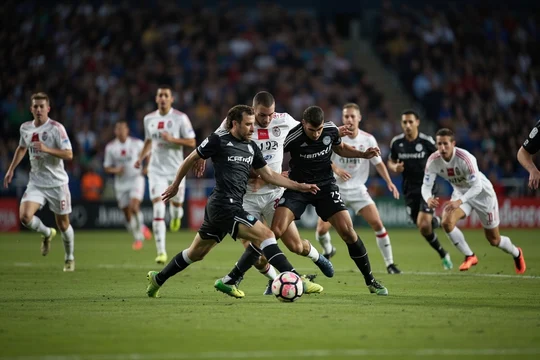
The German top flight operates under a structural framework where the regular departure of marquee talent to wealthier continental rivals is accepted as routine. Clubs preserve their competitive baseline through youth academies that ensure a continuous talent pipeline from grassroots to the senior level. This internal production is paired with scouting networks that prioritize undervalued, high-ceiling recruitment over brand-name acquisitions. By acquiring young prospects tailored to clear analytical profiles, organizations consistently extract peak athletic value on the pitch while positioning themselves for substantial capital appreciation upon future transfers.
An institutional tactical identity reliably outlasts individual roster turnover. Clubs establish sporting philosophies centered on pressing structures, spatial compactness, and transition dynamics. New arrivals are integrated into pre-existing systems, avoiding the need to rebuild around outgoing stars. The framework includes strict financial governance, shaped by domestic ownership regulations that discourage debt-fueled speculation and mandate operational sustainability. Capital realized from high-profile sales is reinvested into infrastructure, academy operations, and subsequent recruitment cycles, keeping clubs competitive across domestic and European competition.
World-Class Academies Ensuring Continuous Talent Pipelines
The foundation of sustainable squad management in German football lies in the federally mandated network of youth development centers. Following nationwide structural reforms at the turn of the century, professional licenses require clubs to maintain heavily audited academies equipped with elite coaching staffs, modern sports science facilities, and integrated academic support. This centralized standardization ensures that prospective professionals undergo thousands of hours of high-intensity tactical and technical instruction before reaching senior football. Because youth squads frequently employ tactical blueprints aligned with the senior team's operational philosophy, academy prospects develop a mature understanding of spatial awareness, pressing triggers, and transition play. Consequently, when established starters are sold to higher-spending foreign competitors, clubs do not face an existential void; they possess a thoroughly prepared tier of internal replacements who can step into specific tactical roles at a fraction of open-market acquisition costs.
These academies provide a clear pathway to first-team minutes. German sporting directors and head coaches incorporate academy graduates into the matchday rotation, accepting the variability of early-career performances in exchange for accelerated development. Elite domestic and international youth prospects view these clubs as premier development destinations because the route to senior minutes is clear. Promoting prepared academy products into the first team preserves tactical identity and athletic output, keeping the squad competitive on the pitch while remaining financially sound in the global transfer market.
System-Driven Scouting and High-Yield Recruitment
Bundesliga recruitment departments prioritize tactical profiles that align with the club identity when marquee talent departs. Advanced data analytics and global scouting networks identify undervalued players in secondary leagues, lower divisions, and foreign youth setups whose underlying metrics mirror the functional requirements of the team system. Clubs prioritize functional compatibility over market reputation, limiting the performance drop often associated with the loss of elite contributors. The approach generates substantial net capital from player sales while replenishing the squad with younger, high-ceiling assets who can adapt quickly to the league's high-tempo environment.
This continuous talent pipeline relies on structural continuity maintained by sporting directors and technical committees rather than transient head coaches. Prospective recruits are integrated into an established operational pathway where competitive first-team minutes are allocated to developmental talents, accelerating their tactical maturity and market valuation. Because the tactical blueprint remains stable regardless of managerial changes, incoming players enter an environment with clearly defined positional responsibilities, shortening the acclimation period. This disciplined recruitment framework allows clubs to sustain competitive baselines across domestic and continental competitions, turning scouting efficiency into financial stability and on-pitch results.
Tactical Identity Outlasting Individual Roster Turnover
Tactical philosophy in German football governance resides within the sporting directorate rather than any individual head coach. Clubs across the league commit to high-tempo, transition-focused approaches characterized by coordinated counter-pressing, disciplined rest-defense, and direct vertical progression. By establishing these principles as club policy, front offices recruit for precise operational profiles rather than to replace a departing star's individual flair. When an elite central striker or dynamic box-to-box midfielder departs, the scouting apparatus targets specific metrics such as high-intensity sprint capacity, pressing triggers, or progressive pass reception. Incoming personnel then slot into predetermined tactical vacancies without requiring a strategic overhaul.
This structural continuity is further reinforced by tactical alignment extending from the first team down through the developmental academy. Youth prospects are conditioned to understand identical positional responsibilities and spatial patterns, which minimizes the adaptation period when internal talent is promoted to absorb minutes vacated by high-profile sales. Because the collective system dictates performance rather than individual isolation play, tactical cohesion regularly compensates for temporary deficits in raw star power. Opponents consistently encounter a coherent collective whose synchronized pressing traps and transition mechanics remain recognizable regardless of personnel changes. By treating individual athletes as functional components within an overarching strategic framework, clubs preserve baseline efficiency and maintain domestic and continental competitiveness despite regular roster churn.
Sustainable Financial Models and Reinvestment Discipline
German football operates under rigorous regulatory oversight and licensing frameworks that inherently discourage unchecked deficit spending. When a club completes the lucrative sale of a marquee talent, the board rarely authorizes a direct, equal expenditure on a single replacement. Instead, standard financial governance dictates that windfall profits are partitioned across multiple institutional needs. A substantial portion of the proceeds is absorbed into operational reserves, training facility enhancements, and academy funding, rather than inflated player salaries. By maintaining strict wage-to-turnover ratios, clubs prevent the wage inflation that frequently destabilizes mid-tier European competitors, ensuring that the departure of a high-earning focal point simultaneously restores wage structure balance and reduces long-term fixed liabilities.
On the recruitment side, reinvestment follows a structured, portfolio-based approach designed to mitigate market volatility. Rather than pursuing established names with depreciating resale value, sporting directors routinely allocate the proceeds of one major departure toward acquiring multiple high-ceiling prospects and targeted squad depth. This strategy diversifies performance risk; if one incoming player struggles to adapt, the financial and tactical burden does not jeopardize the entire season. Coupled with performance-weighted contract structures and moderate buyout valuations, this disciplined reinvestment cycle ensures that the club continually refreshes its talent pipeline, generating future competitive viability and ongoing transfer market value.
Conclusion
Bundesliga clubs remain competitive by structuring their entire sporting infrastructure around planned roster turnover. Coordination between elite youth academies and high-yield, system-oriented recruitment ensures that replacement pipelines are operational long before key departures finalize. Furthermore, by embedding defined tactical identities into the fabric of the club rather than relying on individual star profiles, technical leadership ensures that on-pitch execution remains stable regardless of player transitions.
This structural resilience is safeguarded by strict financial models that prioritize reinvestment and fiscal discipline over speculative spending. Rather than absorbing the financial shocks of player churn, clubs use outgoing transfer fees to fund sustainable squad depth and modern facility development. By treating player development and transfer cycles as an interconnected ecosystem, German football proves that strategic clarity and institutional consistency can consistently outperform individual star power over the long term.