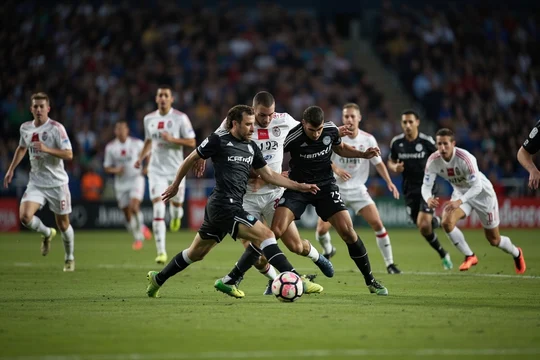
The Bundesliga runs on a buy-low, develop, sell-high model, and the reason starts with ownership. The 50+1 rule requires the club's members to hold the controlling vote, which blocks private investors from taking majority stakes and from covering losses with fresh equity. Clubs fund deals and wages from matchday income, broadcast distributions and commercial revenue, so wage bills stay tied to turnover and the chase for elite talent concentrates at Bayern Munich and Borussia Dortmund. Bayer Leverkusen (through Bayer) and Wolfsburg (through Volkswagen) hold historical exemptions, but they operate inside the same shared broadcast pot and a broadly similar wage structure.
Inside those limits, German clubs run a cycle with three moving parts: producing players, buying them cheaply and selling them on. Each sale funds the next signing, each academy intake has to clear a high bar, and every incoming player arrives with an implicit exit plan.
Academies as the Base Layer
The modern German academy system dates to the DFB's rebuild after the national team's group-stage exit at Euro 2000. Licensed clubs must run certified academies with full-time coaching staff, dedicated facilities and a dual-education model that keeps players in school alongside training. Players usually enter between 14 and 16, sign academy contracts, move through the age groups and then into a reserve side playing in the third or fourth tier. The result is a steady supply of players who are technically and tactically ready for senior football somewhere between 17 and 21.
Academy output matters more to Bundesliga squad economics than in most top leagues. A graduate costs a fraction of a transfer fee, arrives knowing the tactical framework and, when sold, returns a multiple of the investment. Borussia Dortmund, VfB Stuttgart and Schalke have historically produced players who graduated to the first team before moving abroad, generating revenue and filling roster gaps at the same time.
How long a club holds its graduates depends on its tier. The top sides, with bigger wage bills and European income, keep their best academy products longer and sell later, often in the player's early-to-mid twenties. Mid-table clubs on tighter margins usually sell earlier, most often to Premier League buyers. To manage the risk of losing a player too soon, clubs use long contracts, sell-on clauses and buy-back options that allow them to reacquire a player who keeps developing. Proceeds pay for youth staff, facility upgrades and first-team signings to replace the graduates who leave.
Scouting Networks and Target Profiles
Most top-flight clubs run scouting networks that combine regional observers, video analysts and data specialists. Coverage is split into geographic zones, each with a head scout who watches the lower divisions, youth set-ups and amateur football in that area. Bigger clubs keep permanent recruitment staff across Europe, Africa and South America.
Neighbouring markets carry most of the load. Austria, Switzerland, the Netherlands, Belgium, Scandinavia and the French second tier offer short travel, shared languages and similar playing cultures, which makes integration easier, and their price-to-quality ratio suits clubs on tight wage structures. Portuguese football and the Austrian and Swiss top flights are regular sources for mid-table and relegation-threatened sides. Brazil, Argentina and other South American markets have become more frequent targets, though clubs often prefer players who have already completed a spell in Europe. West Africa, North America and Japan form smaller, more selective channels.
The process is layered. Video platforms handle early identification, analysts flag players who meet preset criteria for technique, physical output or tactical discipline, and data overlays built on event tracking and physical metrics narrow the list before a live scout watches the player in person.
Target profiles are narrow. Most signings fall between 18 and 23, the window where the price is lowest and the resale upside is largest. Position-specific checklists combine measurable traits such as sprint times, aerial duel rates and expected assists with harder judgements like decision-making under pressure and consistency across a season. Scouts favour players who already show one elite trait, even if the rest of the profile is raw, because the club's coaches are expected to add the missing layers. Physical markers matter too, given the league's high pressing.
Mapping Gaps Before Bidding
Shortlists start from a positional map. The sporting director and head coach agree on the formation for the coming season and then audit each line of the squad: contract length, age curve, injury history, minutes logged by backups and the readiness of academy players or returning loanees. A position counts as a gap only when internal options cannot cover the expected minutes at a competitive level, which separates structural need from a luxury upgrade. This audit typically runs 12 to 18 months ahead of the window.
Each gap then gets a budget. A starter-level hole at centre-forward, ball-playing centre-back or creative midfield takes the largest share, while depth at full-back or second striker is filled through free agents, loans or youth promotion. Profiles are written before any bid, covering age, contract length, resale logic and fit in the coach's pressing structure. Exit scenarios are modelled in parallel, so the club knows who leaves before it commits a fee to a replacement. That sequencing reduces the risk of buying in a thin market without a matching sale.
Free Agents and Value Signings
Free transfers are a core part of roster building. Clubs identify players entering the final year of their contracts and move before a bidding war starts. Typical targets include established starters aged 26 to 30 coming off strong seasons, prospects at clubs facing financial pressure or relegation, players out of favour at richer clubs and experienced professionals returning from long injuries. Without a fee, a club can offer a larger signing bonus and competitive wages without inflating its transfer outlay. Centre-backs, defensive midfielders and backup goalkeepers make up a large share of free-agent signings because those roles add value with little dependence on goal output.
Selling clubs know this. Homegrown players who do not break into the first XI often leave on free transfers or modest fees once their contracts enter the final year, so negotiations usually speed up as the twelve-month mark approaches. Clubs in the upper half also buy established starters from mid-table rivals, paying a premium for proven Bundesliga experience over the risk of an unproven import.
Loans as Development and Cover
German clubs use loans for two separate jobs. The first is development. A fringe player can spend a season in the 2. Bundesliga or at a partner club, make 25 to 30 senior appearances and return with a stronger claim to a place or a higher valuation. Mandatory playing-time clauses and option-to-buy structures turn these moves into low-risk auditions. The lending club keeps the upside if the player breaks through and recovers costs or earns a fee if he does not.
The second job is tactical cover. A mid-table side that loses a left-back to injury for three months can fill the hole without spending transfer budget or a senior roster spot, and a club can test a player inside its system before paying a permanent fee. The loan acts as insurance with a fixed cost, a defined end date and an exit if the fit fails. Wage contributions from the parent club, often negotiated between 30 and 70 percent, cut the borrower's exposure. Loans within the Bundesliga are common because the arriving player already knows the league's pressing rhythm and transition patterns, which shortens the adaptation period that a cover signing is meant to avoid.
The same network helps clear the squad. Partnerships with smaller clubs, in the 2. Bundesliga or neighbouring leagues, give reliable destinations for a backup midfielder or third-choice centre-back who has slipped down the depth chart. Moving him out with an option or obligation tied to appearances trims wages while protecting his sell-on value. Bundesliga sides increasingly prefer purchase obligations to options in these deals, because an obligation fixes the outcome and counts toward amortisation straight away instead of leaving the decision open at the end of the season.
Contracts, Sell-On Clauses and Profit
Contract length is a valuation tool. First-team players usually sign for three to five years, and academy graduates under 23 sometimes go to five or six. Players over 30 tend to get two or three years because the value curve turns against a club paying a fee for someone near the end of his prime. Long deals give the club more amortisation runway and a stronger position when a bigger offer arrives. Some clubs prefer stepped annual wage rises to flat terms, so the salary stays competitive if a bidding war starts.
Germany has no statutory buyout equivalent to Spain's compulsory release clauses, so any exit fee in a contract is a private negotiation. Clubs usually set the figure high enough to deter speculative approaches while leaving room to negotiate down when a sale suits their sporting and accounting calendar.
Sell-on clauses give the original club a share of any future fee and are now standard in academy deals, often in tiers that rise as the resale price crosses agreed thresholds. They let a smaller club accept less upfront in exchange for a stake in the player's upside. As a worked example, a club that sells a 19-year-old forward for €5 million with a 20% sell-on would collect a further €8 million if he later moved for €40 million. Some clubs accept less today for a bigger percentage later; others take a flat fee and waive the clause.
Amortisation widens the margin on the books. A player signed for €15 million on a five-year deal has a book value of €12 million after one season, so a €30 million sale registers roughly €18 million of accounting profit before taxes and agent fees. The typical arc runs from signing at 16 to 20, senior football between 18 and 22 and a sale between 22 and 26, when buyers can price the player on first-team data and there is still resale upside. The Premier League takes most of these departures and pays the highest fees, with La Liga and Serie A taking smaller shares. Because the domestic broadcast deal is smaller and 50+1 limits outside capital, player trading sits alongside matchday and sponsorship income as a primary revenue line. It is how clubs stay competitive while selling stars every summer.
Wage Discipline and Relegation Risk
Promotion and relegation force transfer departments to price in a downside. Going down costs broadcast revenue, resets sponsorship deals and triggers player exits, so contracts routinely include relegation clauses that cut wages by a fixed percentage. As an illustration, a €4 million-a-season deal might drop to €1.5 million for a year in the second tier. Agents push back, but clubs hold the line because the alternative is a wage bill that breaks the budget once results turn. Free agents who demand three- or four-year guarantees often end up elsewhere.
The same caution applies higher up the table, where a five-year contract for a 29-year-old striker becomes a sunk cost if he declines. Scouts skew younger, and resale value outweighs the headline fee.
The constant churn shapes the football. A mid-table side might lose three or four first-choice players in one window and replace them with cheaper, younger alternatives who need time to adapt. Coaches build systems around pressing, vertical transitions and positional flexibility that hide technical gaps, with established starters and homegrown veterans anchoring the side while prospects rotate through. Clubs that scout well and manage minutes carefully keep finishing above their wage bill. Clubs that miss on recruitment, or whose best young players stall, end up with thin squads and little room to correct course before the next window. Newly promoted sides that spend heavily on wages to survive show the cost of breaking the model, since many of them return to the 2. Bundesliga within a season or two with a squad built for a division they no longer play in.