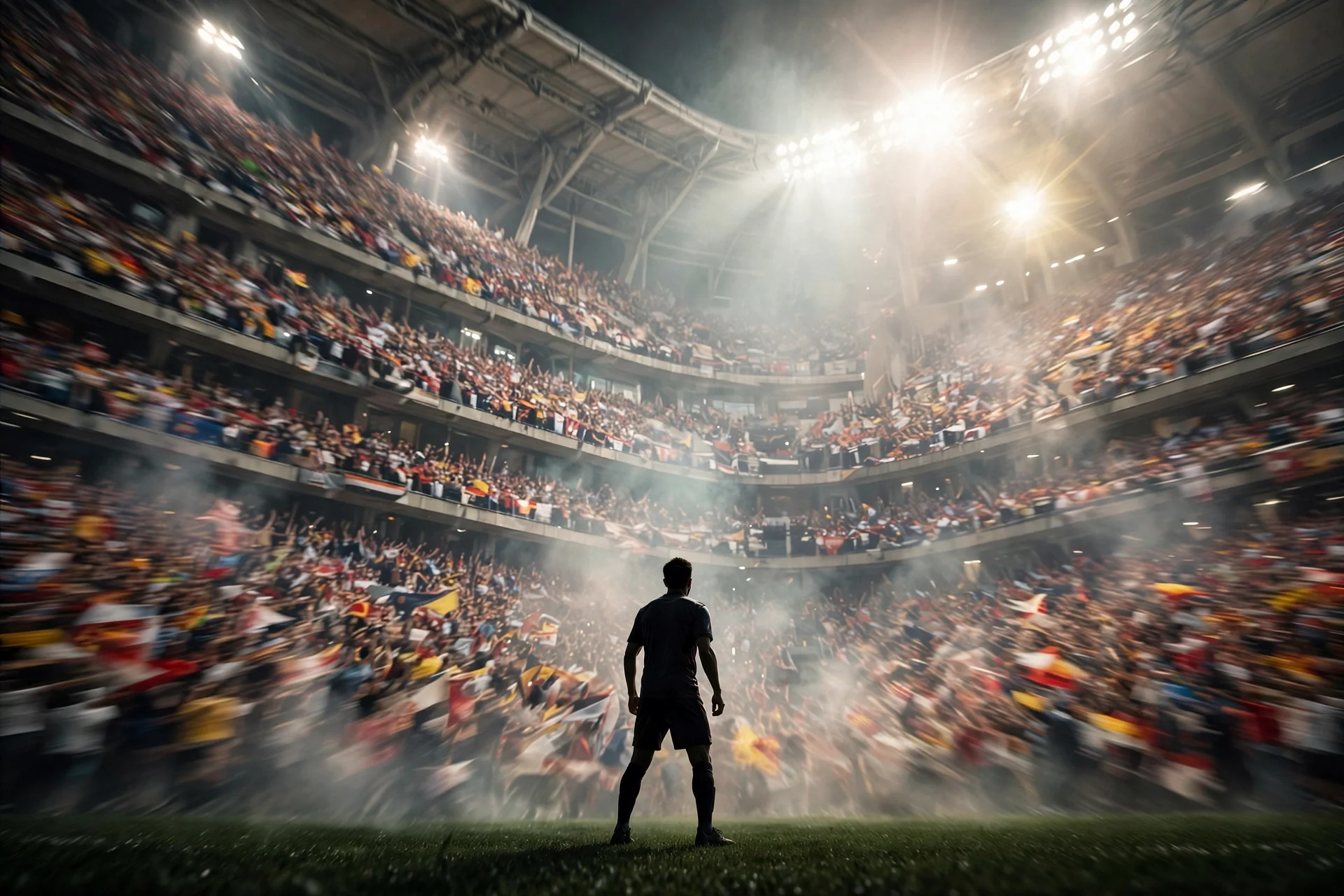
The Turkish Süper Lig's intense stadium atmospheres function as a competitive factor. This phenomenon is rooted in structural and acoustic stadium design, where steep seating gradients, enclosed roof canopies, and proximity to the pitch trap and amplify crowd noise, creating severe acoustic cauldrons. The resulting sensory overload places psychological pressure on visiting players and match officials. Referees, subjected to constant sonic hostility, frequently experience subconscious bias during high-stakes penalty and disciplinary evaluations, while visiting squads suffer cognitive fatigue and disrupted on-pitch verbal communication. Confronted by this environment, away coaches often make significant tactical compromises, abandoning proactive possession structures in favor of compact, conservative defensive blocks and direct play to mitigate the hosts' crowd-driven momentum.
Sports analytics quantify this atmospheric influence, converting subjective stadium lore into empirical data. Predictive models incorporate home advantage through expected goal differentials, shot volume disparities, and referee foul-calling margins, placing the Süper Lig as an outlier compared to many peer competitions. Analysts measure how crowd density and localized hostility consistently raise the baseline performance metrics of host clubs while suppressing away outputs. These probabilistic shifts feed into predictive modeling and sports betting assessments to establish fair pricing, where shifts in win expectancy require objective data and responsible gambling practices. These architectural, psychological, and statistical dynamics show how regional environments shape elite competition.
Psychological Pressures on Opponents and Match Officials
The intense sensory environment characteristic of Turkish Süper Lig venues places a measurable cognitive load on visiting squads, altering both individual execution and collective tactical discipline. Sustained acoustic pressure, generated through coordinated chants, persistent whistling, and rhythmic percussion, frequently compromises on-pitch verbal communication between central defenders, holding midfielders, and goalkeepers. Deprived of clear auditory cues, away players are forced to rely more heavily on visual scanning, which slows reaction times during rapid defensive transitions and high-pressing sequences. Over the duration of ninety minutes, this perpetual hostility raises stress levels, often leading to unforced technical errors, rushed decision-making in possession, and a tendency toward cautious, low-risk passing that dampens the visiting side's attacking potency.
Match officials are subjected to an equally demanding psychological dynamic, operating in stadiums where proximity to the pitch amplifies every reaction. While professional referees are trained to maintain absolute impartiality, sports psychology literature consistently indicates that extreme acoustic volume can subconsciously influence split-second judgment, particularly during subjective assessments such as penalty appeals or disciplinary thresholds for yellow cards. The immediate, deafening roar of collective dissent following a contested challenge creates an implicit confirmation bias, raising the psychological cost of issuing a controversial decision against the host club. Consequently, the sheer intensity of the home crowd can subtly sway the margin of error, often resulting in home sides receiving the benefit of the doubt on borderline 50-50 calls and stoppage-time management.
Tactical Compromises Forced by Hostile Crowds
The auditory intensity characteristic of Turkish stadiums exerts a direct influence on the operational mechanics of visiting sides, altering their baseline tactical plans. When ambient decibel levels eliminate reliable verbal communication between goalkeepers, central defenders, and holding midfielders, build-up play from the defensive third becomes inherently volatile. Visiting managers frequently respond by abandoning patient, short-passing sequences in favor of a direct approach designed to bypass the home team's initial pressing wave and clear the ball into contested zones further up the pitch. Furthermore, away sides regularly compress their defensive structures into a disciplined low-to-mid block rather than deploying an aggressive high line. This calculated retreat limits the space available between the lines, minimizing the risk of midfield turnovers that energize the home supporters and generate dangerous transitional moments.
These tactical concessions force visiting teams to accept significant structural compromises, particularly regarding offensive output and territorial control. By prioritizing defensive solidity and risk aversion, wide midfielders and full-backs are constrained to their own half, which severely isolates the central striker and reduces effective counter-attacking avenues. In quantitative analysis and sports betting markets, where home-field advantage in such environments is priced into goal expectancy models and match odds, these behavioral shifts illustrate why visiting sides typically produce lower offensive metrics and fewer high-probability scoring opportunities. Analysts and bettors evaluating these tactical patterns must always treat such wagering considerations through the lens of responsible gambling, recognizing that while deep defensive postures are intended to neutralize the crowd, they depress an away team's capacity for proactive attacking play.
Structural and Acoustic Stadium Architecture Influences
The physical design of modern venues across the Turkish top flight plays a definitive role in converting raw supporter passion into a measurable competitive edge. Many of these grounds feature steep, tightly stacked seating tiers engineered to position spectators remarkably close to the touchlines, eliminating the physical and visual buffer zones found in multi-purpose arenas with running tracks. Furthermore, the extensive use of low-hanging, tensile fabric roofs and solid overhangs creates an acoustic shell that traps and reflects sound back toward the pitch rather than allowing it to dissipate into the atmosphere. This architectural resonance significantly amplifies decibel levels, generating a sustained acoustic pressure that interferes with the opposing team's verbal communication. Goalkeepers and central defenders routinely struggle to coordinate defensive lines, reorganize marking during set pieces, or communicate tactical shifts over the pervasive ambient roar.
Beyond disrupting tactical mechanics, the architectural amplification of sound exerts profound psychological pressure on both visiting squads and match officials. Prolonged exposure to high-intensity acoustic environments increases cognitive load, which often leads to technical errors, rushed decision-making, and unforced turnovers by visiting players under intense pressing. This sonic containment also heightens the perceived magnitude of every tackle, foul, and contested event, which magnifies home appeals during marginal penalty-box or disciplinary incidents and shapes officiating dynamics. Performance analysts and market modelers frequently account for these venue-specific structural variables when calculating home advantage metrics and pricing match outcomes because a stadium's acoustic blueprint directly influences game flow. Anyone evaluating these environmental factors from a wagering perspective should carefully weigh structural dynamics against broader team form and adhere strictly to principles of responsible gambling.
Quantifying Home Advantage in Analytical Models
In modern football analytics, quantifying home advantage requires translating psychological and environmental pressures into tangible statistical variables. Within the context of the Turkish Süper Lig, where crowd engagement is exceptionally fervent, data scientists typically capture this phenomenon by isolating home-away differentials across expected goals, shot volume, and spatial control metrics such as field tilt. Predictive frameworks, including bivariate Poisson distributions and modified rating algorithms, routinely assign a higher baseline constant to host clubs to account for these systemic disparities. Beyond purely tactical outputs, analytical models frequently incorporate disciplinary metrics, evaluating how severe crowd noise alters officiating variance regarding foul calls, stoppage time duration, and card frequency. By standardizing these performance indicators over multi-season samples, analysts establish an objective baseline of how effectively the physical setting amplifies a host team's chance creation while dampening the opposition's attacking efficiency.
These empirical measures directly inform tactical preparation and probability pricing across the sport. In quantitative modeling for match forecasting, the Süper Lig historically commands a higher home parameter than many other domestic competitions, leading analysts to adjust win probabilities and handicap spreads accordingly. While these probability models are often used in commercial betting markets to identify statistical discrepancies, engaging with such markets carries inherent risk, requiring strict adherence to responsible gambling principles and objective risk management. On a tactical level, coaching staffs rely on these statistical profiles to design specialized away strategies. Away teams often deliberately structure deeper defensive blocks, implement time-management tactics during dead-ball phases, and prioritize high-retention passing sequences to suppress the statistical surges typically generated by an energized home environment.
Conclusion
The pronounced home advantage observed across the Turkish Süper Lig represents an intersection of structural engineering, psychological strain, and tactical disruption. Steep stadium architecture and focused acoustic designs transform regional grounds into high-pressure environments that directly alter performance dynamics. Visiting squads routinely face an intensified cognitive burden that accelerates fatigue and undermines execution, while match officials must operate under ambient pressures that can subtly shape marginal decisions. Consequently, visiting managers are frequently compelled to implement tactical compromises, abandoning open build-up structures in favor of compact, conservative shapes to mitigate the crowd-fueled momentum of their hosts.
Translating these atmospheric conditions into analytical frameworks confirms that the league's environmental factors generate a measurable deviation from neutral performance baselines. Data analysts and predictive modelers increasingly work to isolate this variable from standard squad strength, quantifying how localized noise and visual density impact possession value and refereeing patterns. Whether used for high-level tactical scouting or broader probabilistic forecasting, where responsible gambling principles govern the interpretation of statistical risk, the domestic home atmosphere is an active strategic variable that shifts outcomes on the pitch.